

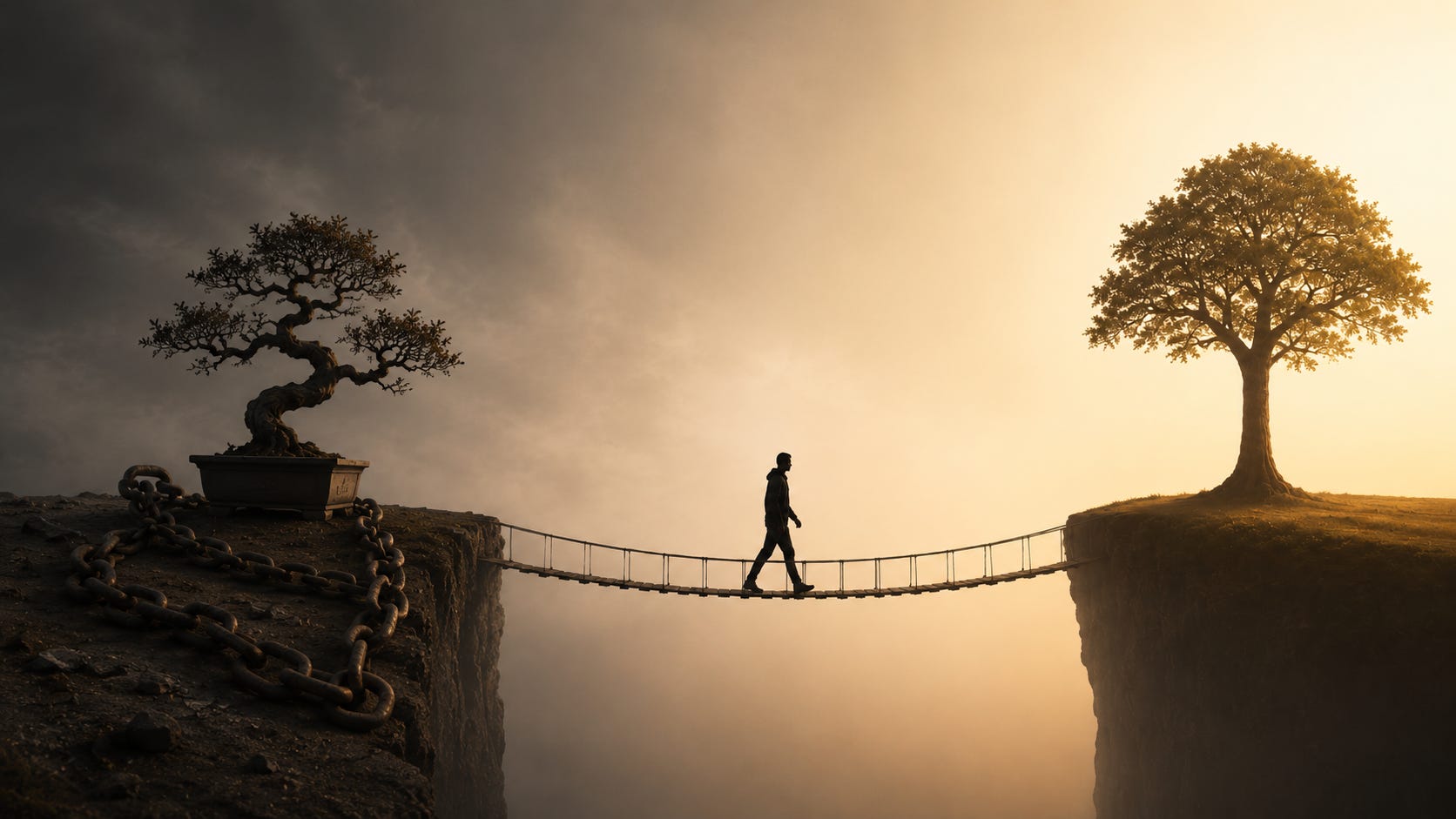
There are moments in life when we know we can no longer remain who we’ve been.
The old beliefs no longer fit. The old identity feels too small. The old explanations no longer satisfy.
Yet, even as we recognize this, we often cannot see clearly what comes next.
Most of us have been here before.
A relationship ends, but we’ve not yet learned how to be alone.
A career stops aligning with our purpose, but we’ve not yet found our next calling.
A belief system begins to crumble, but a new understanding has not yet taken its place.
A person awakens to the distortions that shaped their life, but hasn’t yet become who they’re capable of becoming.
Many people may read these moments as confusion. Others may read them as failure. Some will read them as evidence that something is wrong with them.
I’ve come to believe, something different.
I’ve come to believe that much of life is spent in what is called a liminal space.
A liminal space is a kind of wilderness.
Biblically speaking, Black people are very familiar with the wilderness. It’s the place between Egypt and the Promised Land. It’s where Israel walked after the chains came off, but before they reached the land they were promised. No longer slaves, but not yet home. The long stretch in between.
The wilderness is not a place you pass through in a moment. It is a place you live in for a season. It strips you of what you were. It tests you. It asks, who are you with Egypt behind you and Canaan not yet in sight?
This is liminality. The condition of the in-between.
You’re no longer who you were. You’re not yet who you are becoming. You are between worlds.
I believe it is one of the most important and least understood parts of human development. It’s also the missing piece in my own work.
How the shaping happens
I’ve conceptualized what I call the Bonsai Theory.
It begins with a simple observation. A bonsai tree is not small because smallness is its destiny. It is small because its growth was shaped, restricted, and redirected by forces outside itself.
People experience the same thing.
Family shapes us. Community shapes us. School shapes us. Religion shapes us. Media shapes us. History shapes us. Social conditions shape us.
Over time, many of us adapt to environments that ask us to become something less than we might have been. We learn to survive. We learn to fit in. We learn to perform. We learn to suppress.
Our ability to adapt has helped us survive harsh circumstances. But survival and freedom are not the same thing.
Eventually, some people begin to notice the shaping. They recognize the distortions. They question the assumptions they once accepted without thinking. They begin to see that parts of their identity were built in response to conditions, rather than in alignment with their deepest humanity.
And this is where it becomes uncomfortable.
Because awareness is not freedom. Seeing the cage doesn’t open it. And recognizing the distortion does not produce clarity.
Something else happens first.
You enter the wilderness.
Awareness is the way in. It is not the way out.
The old self begins to loosen its grip. The new self has not yet arrived. You are suspended between adaptation and reconstruction. Between who you were conditioned to become, and who you are capable of becoming.
You may notice it first as a kind of distance.
Places that once felt like home begin to feel unfamiliar. Conversations that once made sense now feel hollow. Relationships shift under you without warning. Certainties you never thought to question begin to dissolve. You catch yourself examining assumptions that guided you for years.
The discomfort is not proof that something is wrong with you. It may be the first evidence that something is changing.
A wilderness our people understand
More than a century ago, W.E.B. Du Bois described a particular kind of inner division. He wrote of two souls inside one body, two ways of seeing, two strivings that refused to reconcile. He called it double consciousness. He said our people were born with a kind of second sight, always measuring themselves through the eyes of a world that did not love them.
I want to suggest something about that condition.
I submit to you that Double consciousness is, in many respects, a liminal condition.
It is the experience of being caught between the self the world demands and the self you sense underneath. One's self was shaped to survive the gaze. The other has been waiting to be reclaimed. To live in double consciousness is to wander a wilderness you did not choose, between a self that was assigned and a self that is real.
On the far side of that wilderness is what I call the Reconstructed Self.
If Bonsai Theory describes the self that was shaped without your consent, the Reconstructed Self describes the self you build on purpose. It is not the self the world assigned you. It is not the self you performed in order to survive. It is the self you reclaim once you can see the shaping clearly and choose, on your own terms, who you will become.
Not two warring selves. One aligned self. The crossing is where the war ends and the alignment begins.
And there is a larger wilderness beneath the personal one.
When the chains were broken off, our ancestors were told that they were free. But freedom was announced long before it was delivered. The law changed, but the conditions did not. We had come out of Egypt, and we were left to wander.
So, our people were placed in a wilderness of our own. Between the bondage that ended and the Promised Land that was named but kept from us. And we’ve been walking in the wilderness for generations. No longer who we were forced to be. Not yet who we have every right to become.
Why people get stuck
Here is the danger of the in-between.
Some people get trapped in it.
They spend years lingering between awareness and action. Between insight and reconstruction. Between knowing and becoming. They never return to who they were, yet they never fully step into who they might be. They end up building a home in the wilderness.
Scripture tells this story. The generation that walked out of Egypt wandered for forty years, and most of them died in the wilderness without ever reaching the Promised Land. Freed from bondage, and yet they still did not cross over. Egypt was behind them. The promised land was ahead of them. And they spent their lives in the in-between.
Some may believe this is a failure of will. It is not.
Consider how our ancestors made this crossing before us.
Across the African world, the passage from one stage of life to the next was never left to chance. Our ancestors built rites of passage. The young were separated from the old life, carried through a season of transition, and returned to the community as someone new, with a new name, a new role, and a new place among the people.
paul hill jr., who founded the National Rites of Passage Institute, carried this tradition into our community in our own time. He understood a hard truth. A people who lose their rites of passage lose the way they once carried their young from one self into the next.
Here’s what matters most.
No one was left alone in the “in-between”.
Elders stood watch. Ritual gave the transition a shape. The community held the person until they could be carried across. The crossing had a structure, and the structure had hands.
Today, we have largely lost that. The masses of our people cross alone and unnamed, with no elder to walk ahead of us, no ritual to mark the passage, no map for the in-between. We wake up to the distortion, and then we are left to find our own way through the wilderness with nothing in our hands.
That is why people get stuck. Not because they are weak. Because the bridge is gone.
People do not get trapped in the wilderness because something is wrong with them. They get trapped because no one built them a bridge.
What the work actually is
This is the work in front of us. To rebuild the structure we lost. To become the elder who walks ahead. To make a ritual for the passage. To draw a map for the in-between.
And the five pillars of the Reconstructed Self are not a theory. They are the labor of the wilderness itself. They are what you actually do while you are walking through it.
You Unlearn. You let the shaped self loosen its grip.
You Reclaim the Mind. You take back the territory that was redirected.
You Align Identity. You end the war between the assigned self and the real one.
You hold Discipline and Boundaries. This is what keeps you moving instead of settling in the wilderness.
You Activate the Reconstructed Self. You cross over into the Promised Land.
The wilderness only looks empty, but it’s where the reconstruction happens.
Bonsai Theory explains how the distortion happens.
Liminality explains the crossing.
The Reconstructed Self explains who you become on the other side.
Awareness is the way in. Reconstruction is the work between. The Reconstructed Self is the way out.
This is the bridge I have been missing. This is the piece that was always there and never named.
To anyone in the wilderness
If you are reading this from a wilderness of your own, hear me clearly.
Uncertainty is not always failure. Sometimes uncertainty is the evidence of growth. Sometimes confusion is what it feels like to outgrow an identity that no longer fits. Sometimes the discomfort is the old self dying so the real one can live.
The purpose of the wilderness is not to remain in it. Its purpose is reconstruction. Its purpose is growth. Its purpose is emergence. Its purpose is freedom.
The task is not to have all the answers. The task is to keep moving and not build a home in it.
That takes courage. Not the kind that removes fear. The kind that allows movement in spite of it all.
So to everyone walking through a wilderness right now, unsure of what comes next, I will tell you what I have always said.
Keep your head up and keep pushin’.
Dr. Timothy D. Goler is a sociologist and author of Liberated Mind: A Guide to Black Clarity. Learn more at www.timgoler.com
Amazing piece ! Don’t stay in the wilderness! Keep pushing !