
What if the greatest threat to human freedom is no longer physical control, but control over human attention?
What if the most powerful systems in the modern world are not the ones that control land, weapons, or governments, but the ones that quietly shape what people focus on, fear, desire, consume, and believe?
And what happens to a society when millions of people can no longer sit alone with their own thoughts?
I’ve been thinking about that a lot lately.
Because the most valuable thing you own isn’t your house. It isn’t your retirement account. It isn’t your degree. It isn’t your title. It isn’t even your money.
It’s your attention.
Because wherever your attention goes, your life follows.
On the surface, we have access to more information than any generation in human history. We can learn almost anything. We can communicate with people across the globe instantly. We carry more knowledge in our pockets than entire libraries once contained. Yet many people have never felt more overwhelmed, more distracted, or less certain about who they are. I don’t think that’s an accident.
I believe we’re living through one of the greatest battles for human consciousness ever witnessed. And artificial intelligence raises the stakes even higher.
The central question of the AI age is not whether machines will become intelligent. The central question is whether human beings will remain intentional.
Every day, somebody is competing for your attention. Social media companies want it. Advertisers want it. Political organizations want it. News outlets want it. Streaming platforms want it. Corporations want it. And now artificial intelligence is rapidly becoming part of that ecosystem. Not because attention is valuable in itself, but because attention is the doorway to influence.
Whoever captures attention gains an opportunity to shape perception.
Perception influences belief.
Belief influences identity.
Identity influences behavior.
And behavior, repeated over time, becomes destiny.
This is why attention has become one of the most valuable commodities on Earth.
Entire industries now spend billions of dollars studying human behavior. They analyze what makes us click, what makes us angry, what makes us afraid, what makes us stay, what makes us buy, and what keeps us coming back for more. Every notification, recommendation, headline, advertisement, and algorithm is competing for space inside the most valuable territory you possess: your mind.
For the first time in human history, we are creating systems capable of learning our habits, predicting our preferences, anticipating our questions, and responding to us in increasingly personal ways. AI can learn patterns from our behavior. It can predict what might interest us. It can personalize what we see. It can shape the information environment around us with remarkable precision.
I’m not afraid of artificial intelligence.
But I am concerned about human passivity.
Because the more technology learns about us, the more important it becomes that we know ourselves.
The more sophisticated algorithms become, the more valuable self awareness becomes. The more powerful artificial intelligence becomes, the more necessary human clarity becomes.
If an algorithm knows what captures your attention better than you do, that should concern you.
If a machine can predict your reactions before you’ve examined them yourself, that should make you pause.
If technology understands your habits, fears, desires, and vulnerabilities while you remain largely unaware of them, then the challenge is no longer technological.
It becomes personal.
Do you know what drives your decisions?
Do you know what shapes your beliefs?
Do you know why certain things capture your attention while others do not?
Do you know where your values came from?
Do you know which thoughts are truly your own and which have simply been absorbed through repetition?
These are not abstract philosophical questions anymore.
They are practical questions for anyone who wishes to remain free.
Most people think freedom means being able to do whatever they want. I’m no longer convinced that’s the best definition. To me, freedom begins with the ability to govern your own mind. To direct your own attention. To choose what deserves space in your consciousness. To sit quietly with your own thoughts without needing constant stimulation, validation, distraction, or noise.
And that’s becoming harder.
Many people can spend three hours scrolling but struggle to spend ten minutes reflecting. We consume endless information but rarely transform information into wisdom. We’re connected to everybody and disconnected from ourselves. We’re informed about everything and clear about very little.
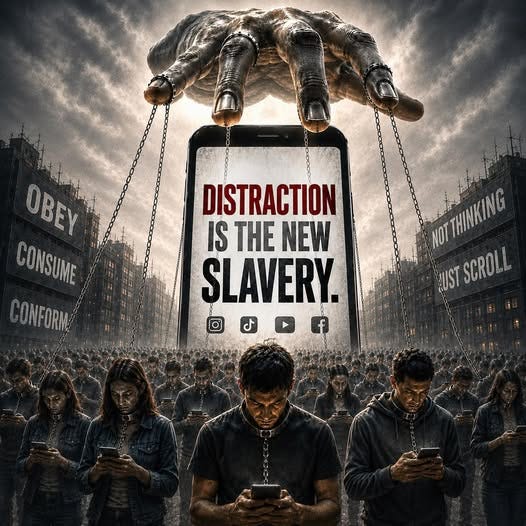
The irony is that many people believe they’re exercising freedom while spending most of their day reacting to things they never consciously chose to focus on in the first place. The phone buzzes. The notification appears. The algorithm serves the next video. The outrage arrives on schedule. The AI recommendation engine predicts what will keep your eyes on the screen. And before long, somebody else is directing mental energy that should belong to you.
That’s why I keep coming back to the idea of clarity.
Not because clarity makes life easier.
Because clarity makes freedom possible.
A distracted mind is easy to influence. A fearful mind is easy to manipulate. A confused mind is easy to control. But a clear mind begins asking different questions. A clear mind pauses before reacting. A clear mind examines assumptions. A clear mind recognizes when somebody is attempting to shape its perception. A clear mind remembers that it belongs to itself.
Perhaps that is the great challenge of our time.
Not simply learning how to use artificial intelligence.
Not simply adapting to new technologies.
But developing the discipline to remain fully human while surrounded by systems designed to capture our attention.
The future will not belong to those who consume the most information. It will belong to those who can still think deeply, reflect honestly, and direct their own minds with intention. It will belong to those who know themselves well enough to engage technology without surrendering themselves to it.
Because in the end, the most valuable thing you own is not your money. It is not your possessions. It is not your status.
It is your attention.
And wherever your attention goes, your energy flows.
The question is simple:
Who has yours?
Dr. Timothy D. Goler
The struggle for clarity, self-awareness, and intentional living in the modern world sits at the heart of my book, Liberated Mind: A Guide to Black Clarity.
Learn more at:
www.timgoler.com