

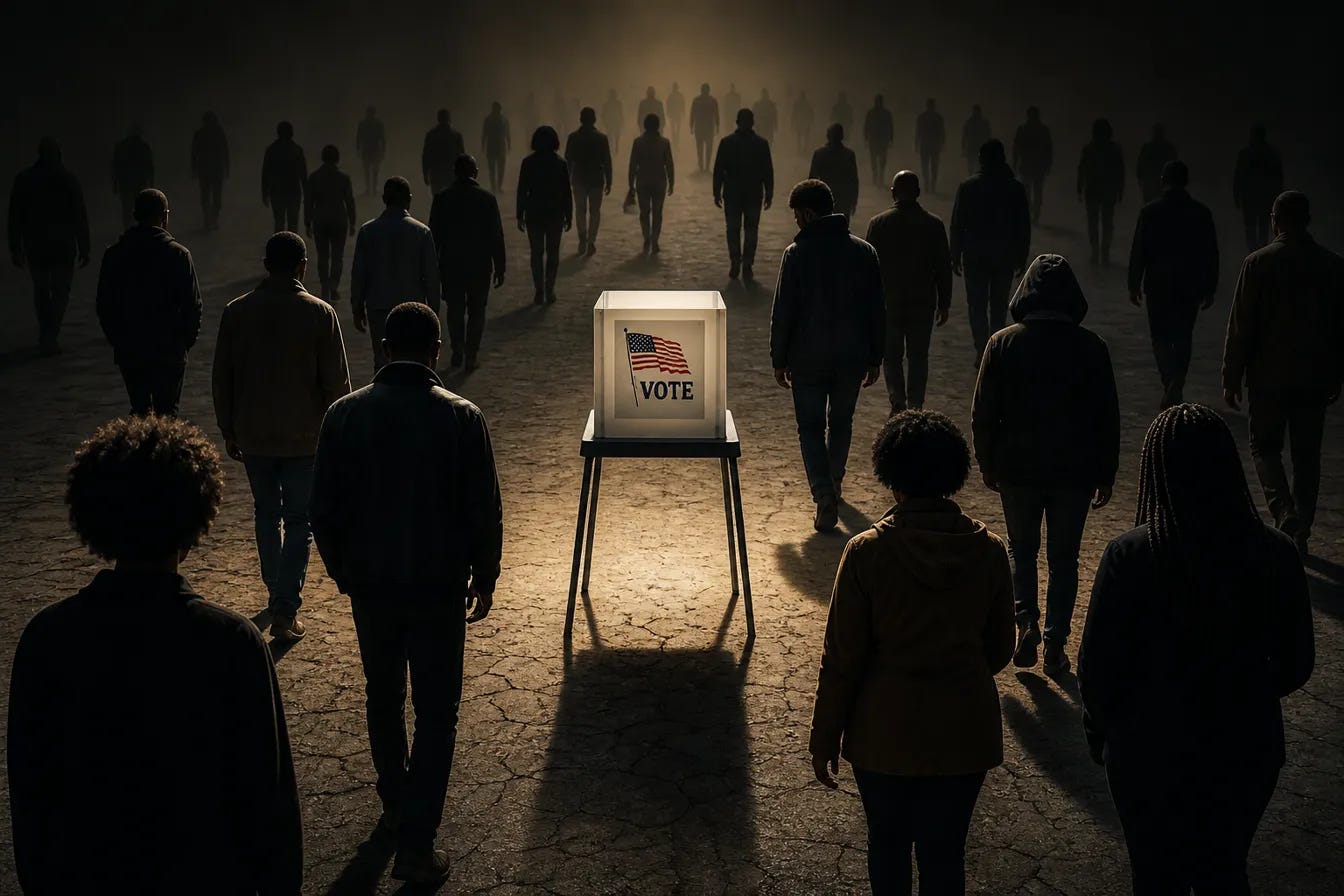
I am angry. I want to start there.
Angry the way a man gets angry when something people bled for is taken away in a six-to-three vote, and the people doing it frame it as fairness.
This ruling did not surprise me. That may be the most unsettling part. When something this consequential feels predictable, it means you have been living inside a truth that others are only beginning to recognize.
The law was never neutral. It was never designed with Black voters as the intended beneficiaries. Access to it was fought for, marched for, and died for. And what was fought for can be reinterpreted, narrowed, and constrained.
That is what this ruling, Louisiana v. Callais, does. It shifts the burden. It is no longer enough to show that electoral maps dilute the power of Black voters. Now the standard moves toward intent, toward proving what was in the minds of those who drew the lines. In a system where plausible deniability is practically a political science, that is not a technical adjustment. It is a structural one.
The Florida House passed a new gerrymander within an hour of the ruling dropping. That is not a reaction. That is preparation.
WHAT THE POLITICAL CLASS IS MISSING
Right now, strategists and pundits are tracking enthusiasm. They are seeing energy: insurgent campaigns, donor surges, progressive fury building into something measurable. The narrative heading into November is don’t underestimate Democratic voters.
They are not wrong about that energy. But they may be misreading what it means.
Enthusiasm and mobilization are not the same thing. And in a cycle where Black voter participation is the margin, where the difference between winning and losing runs through our community, that distinction matters enormously.
What I have been watching for is not outrage. Outrage shows up at rallies. Outrage generates op-eds and donation spikes. Outrage is visible, and visible things get counted in the models.
What I have been watching for is withdrawal.
Not apathy. Not confusion. A decision.
A decision shaped by repeated signals that participation does not guarantee protection. Those gains can be reversed. That access gets narrowed at precisely the moment it begins to work.
In many spaces, the question is no longer simply how to respond to this ruling. It is whether the most visible forms of response have actually been effective. After decades of showing up, organizing, protesting, and voting at high levels, people are reconsidering what that participation has produced, and whether it continues to be met with good faith.
What can appear to be disengagement from the outside is, in many cases, a deliberate recalibration. Less performative. More skeptical. Quieter and harder to measure.
That kind of shift does not appear in polling models. It does not show up in fundraising data. It does not trend.
It simply reduces participation.
And in elections decided by margins that run through Black communities, that is the variable everyone should be watching.
THE FRAGILE GROUND WE HAVE BEEN STANDING ON
Here is the deeper thing I keep sitting with, deeper than this ruling and older than this moment.
Black political power in America was always built on fragile ground.
We fought our way into the Voting Rights Act. Marched into it. Died into it. And we treated it as a foundation, as the floor beneath which we could not fall. But it was never permanently secured. None of it was. The Voting Rights Act, the Civil Rights Act, the gains of the Great Society: all of it was one court, one administration, one political shift away from erosion.
We relied too heavily on legal and political structures as the primary vehicle for freedom, equality, and leveling the playing field. And those structures were never designed with us as the intended beneficiaries. We fought our way into them. And they have been unraveling ever since someone decided we had gotten too comfortable inside them.
What we are watching now is not just a setback. It is the exposure of a structural weakness that was always there. This is what it looks like when power built on someone else’s framework gets called in.
THE CONUNDRUM WE ARE ACTUALLY IN
There is a question moving through Black communities right now that our leadership class has not been willing to take seriously. The question is not whether to vote. The question is how long we continue to absorb the cost of a system that extracts our participation and returns so little lasting value.
That is not cynicism. That is a structural observation. And it deserves a structural answer.
We are living inside a genuine tension. On one side: a country in visible decline. The economic promises have not held. Global standing is eroding. Institutional trust is collapsing across every sector. On the other side: a ruling class actively working to ensure that Black political participation carries less and less weight, not through argument but through architecture. Gerrymandered maps. Gutted preclearance. Manufactured barriers at every point of access.
What that combination reveals is important. Systems do not work this hard to limit influence that has no effect. The ferocity of the attack on Black voting power is, in its own perverse way, a confirmation of how consequential that power actually is. Our vote is still feared. That fear is the most honest signal this system has sent us in years. And it is precisely why November matters.
I am going to vote, and I am asking you to do the same. Not as an expression of trust in a system that has not earned it. But as a final diplomatic stand. A deliberate, clear-eyed act of documentation: we showed up, we did our part, and now the record will show how this country responded.
If outcomes reflect participation, that tells us something.
If they do not, that also tells us something. And that something will require a different kind of response than anything we have tried before.
What we cannot keep doing is absorbing loss after loss, returning to the same table on the same terms, and calling that resilience. It is not resilience. It is the slow erosion of our collective sense of what we deserve and what is possible.
And that erosion does not stay in the political realm. When a system tells you, consistently and through every available mechanism, that your power is conditional, that your presence is an imposition, that the rules will never quite work in your favor, something happens over time. It does not just shape your politics. It shapes your mind. It shapes what you believe you are owed, what you think is achievable, and whether you believe in the possibility of something different at all.
That psychological dimension is where the deepest work has to happen. Because you cannot build durable power on a foundation of internalized defeat. The outer work and the inner work have to move together.
WHAT WE HAVE TO BUILD
Freedom from something is not enough. It never has been.
When your entire orientation is toward what you are escaping, you remain defined by the thing you are running from. The struggle against oppression, as necessary as it is, cannot also be the blueprint for what comes after it. We need a clear vision of what we are building toward, not just what we are fighting against. That distinction is where the real work begins.
We cannot afford to respond to this moment in sequence. The grieving, the fighting, and the building cannot happen one after another. They have to happen at the same time. And right now, not after November, not eventually, we have to begin building the next thing.
The thing that does not depend on courts that can be flipped.
The thing that does not depend on legislation that can be gutted.
The thing rooted in us: in our institutions, our local economies, our congregations, our schools, our psychology, our capacity to define ourselves and our power on our own terms.
This is not a new idea. W.E.B. Du Bois and Carter G. Woodson did not wait for political permission to build. Du Bois helped found the NAACP and launch The Crisis in 1910, in the depths of Jim Crow, when no electoral opening existed, and Black political participation was being violently suppressed across the South. Woodson established the Association for the Study of Negro Life and History in 1915 and created what became Black History Month, not as a celebration of progress but as a form of infrastructure against cultural erasure. They were building knowledge, institutions, and identity in the teeth of a system designed to deny all three. That is what it looks like to build from the inside out, without waiting for the top to hand anything down.
That is the work. The reconstruction of self and community does not require the system’s cooperation to begin. Church leaders, educators, organizers, entrepreneurs, and community builders are already doing pieces of it. What is missing is the connective tissue: a shared understanding that these efforts are not separate from the political fight. They are the infrastructure that the political fight has always needed.
THE WARNING
If November comes and quiet withdrawal plays out, if Black voters step back rather than step up, and the people reading the results do not understand why, we will have missed the most important political signal of this decade.
And if things go the wrong way, the question will not be what happened to the Black vote.
The question will be whether Black leadership is finally prepared to stop making the same bet on the same fragile ground, and to start building something with roots deep enough to hold.
Not after November. Now.
Timothy D. Goler, Ph.D., is a sociologist and author of Liberated Mind: A Guide to Black Clarity, a framework for understanding how systems shape the mind and what it takes to reclaim it. He is the Research Director at the Center for African American Public Policy at Norfolk State University.