

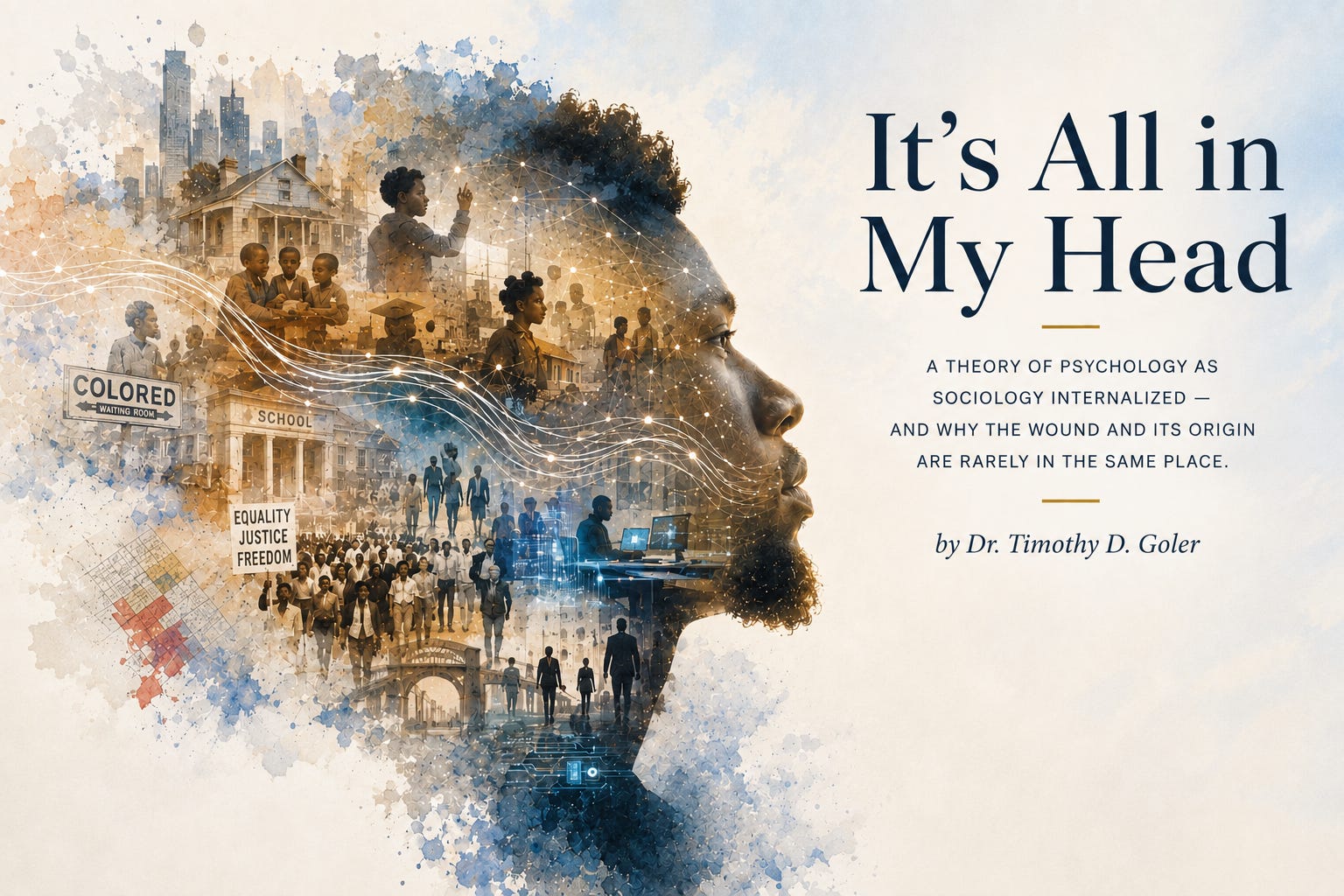
“It’s all in your head.”
Few sentences can be more dismissive. They suggest that because suffering lives inside the mind, its origin must live there too.
But what if that is exactly the mistake?
What if the mind is where we discover the wound, but not necessarily where the wound began?
Liberated Mind begins with a different proposition. Yes, much of what troubles us eventually lives inside our heads. But our heads have never been closed systems. The mind has been in conversation with family, culture, institutions, history, race, class, gender, religion, relationships, and power since before we had language to describe what any of those things were doing to us.
Much of what we eventually call psychology is sociology internalized.
I would not say psychology is sociology, full stop, because that overstates it. Human beings arrive with a nervous system, a temperament, biological needs, sensory capacities, and certain emotional potentials before they understand society. But that sentence above is where I want to build from, because it changes the question many of us ask about our own suffering.
Bonsai Theory, the companion idea I keep returning to, makes the same point in a different shape. A tree grown for years within a restricted container eventually bears the history of that container in its trunk, its roots, the angle of its branches, and its whole pattern of growth, even after the container is long gone or invisible to whoever is looking at the tree.
The environment becomes embodied.
This piece is my attempt to work out where that leaves psychology and sociology, two fields we usually teach, and often live, as if they are answering completely different questions.
A baby arrives capable of fear, attachment, pleasure, distress, curiosity, and connection. But a baby does not arrive knowing what “Black” means, what “successful” means, what “masculine” means, what “beautiful” means, what “poor” means, what “intelligent” means, or what kind of future someone like them is supposedly entitled to imagine.
Biology provides capacities. Society provides categories and meaning. Experience connects the two. Consciousness develops in the space between.
Those meanings have to come from somewhere. They emerge through relationship and culture. The child encounters the social world, then gradually constructs a psychological world from those encounters. So the sequence looks something like this:
Biological organism → social encounter → interpretation → internalization
psychological pattern → behavior → social response → further internalization
And then the cycle keeps going. By adulthood, separating the psychological from the sociological is nearly impossible.
Consider anxiety. Psychology might ask: why is this person anxious? But sociology asks a different set of questions. What conditions produced the anxiety? What environment keeps activating it? What expectations has this person internalized? What social position are they occupying? What relationships taught them what was safe and unsafe? What happened historically before this person ever entered the room?
Now we are getting somewhere different.
The psyche has a social biography
That is the idea I think sits underneath Liberated Mind. Your psychological life has a biography. Your thoughts came from somewhere. Your expectations came from somewhere. Your fears came from somewhere. Even the categories through which you understand yourself came from somewhere.
Sociologist George Herbert Mead gets remarkably close to this: the self develops through social interaction. Charles Horton Cooley gives us the looking glass self theory. We come to see ourselves partly through our perception of how others see us.
But for Black people, W.E.B. Du Bois makes the question much more consequential with his idea of double consciousness. He suggests that society is not merely helping construct a self. A racialized society is attempting to construct a particular kind of self. Du Bois’s insight was that Black people could be forced into the peculiar position of encountering themselves through the gaze of a society that had already assigned meaning to Blackness.
Frantz Fanon pushes it even further. Colonial domination does not stop at the border of the body. It enters consciousness. And once power enters consciousness, domination does not always require an external person standing over you saying, “You cannot.” Eventually a voice can emerge inside saying, “I cannot.”
That is an extraordinary sociological problem masquerading as a psychological one.
This is where Bonsai Theory becomes important
Think about the bonsai again. If the tree grows differently because its roots have been constrained for years, where does the problem reside? Inside the tree? Or in the container?
Technically, by the time you examine the tree, both are. The effects of the container are now expressed through the biology of the tree. The environment has become embodied. So if someone examines only the tree and never investigates the container, they may diagnose the consequence while completely misunderstanding the cause.
When we encounter the shaped tree but cannot see the container that shaped it, what exactly are we diagnosing?
That may be one of the deepest critiques contained within Liberated Mind: we have become very good at naming psychological outcomes while remaining remarkably incurious about the social conditions that produced them.
Depression. Anxiety. Low self-esteem. Hypervigilance. Perfectionism. Imposter feelings. Anger. Distrust. Shame. Even certain forms of ambition.
These certainly have psychological dimensions. But asking only what is happening inside the person can obscure what has happened around the person, between people, across institutions, and through history.
Location is not origin
Anxiety may be located within a person. Shame may be located within a person. Hypervigilance may be located within a person. Feelings of inadequacy may be located within a person.
But location does not establish origin.
That distinction is the central critique here, more than any chicken-and-egg question about which discipline comes first. Psychology encounters the person carrying the consequence. Sociology asks about the social production of the consequence. And Liberated Mind asks how the consequence became incorporated into consciousness in the first place. Those are three different levels of analysis, and collapsing them into one is how we end up treating a person for a container.
This becomes especially visible in relational anxiety. A person can enter a relationship carrying assumptions about intimacy, safety, abandonment, masculinity, femininity, trust, vulnerability, conflict, loyalty, and love that feel deeply personal but were formed long before the present relationship began. Family patterns, earlier relationships, cultural expectations, gender scripts, racialized ideas about love and worth, and previous experiences of safety or betrayal can become part of the emotional architecture we carry into intimacy. The relationship in front of us may activate those meanings, making the present partner the place where an older history is felt. Sometimes the present relationship is where the wound speaks, not where the wound originated.
None of this means biology is irrelevant or sociology comes first in some absolute sense. Biology gives us the capacity for a psychological life; social life gives much of that psychological life its content. And after that, the two become recursive. Society shapes consciousness. Consciousness shapes behavior. Behavior reproduces or resists society. Society responds. Consciousness changes again.
It is a loop, not a starting line.
The wound’s mailing address
The individual may be the location of the wound without being the origin of the wound.
That matters because psychology often encounters the wound at its final address: the person’s mind, the person’s body, the person’s relationships, the person’s behavior. But finding the package at someone’s house does not tell us who mailed it.
Who mailed the shame? Who mailed the inadequacy? Who mailed the belief that Blackness needed correction? Who mailed the fear? Who mailed the definition of beauty? Who mailed the belief that worth had to be earned through extraordinary performance?
Sociology asks us to trace the mail backward. Family. School. Racial hierarchy. Patriarchy. Poverty. Religion. Neighborhood conditions. Media. Historical trauma. A particular relationship. Capitalism. White supremacy. Some combination of these.
Psychology tells us where experience lives. Sociology helps us understand where much of it came from. And liberation requires both, because once society has gotten inside a person, changing society alone may not immediately remove what has been internalized. But treating the individual alone may only teach someone how to survive a container that should have been questioned in the first place.
Society does not only wound us
It would be a mistake to read any of this as saying the social world only injures. Sociology internalized is not only about injury. Society also enters us through love, language, memory, community, culture, imagination, and resistance.
The same social process through which domination can become internalized is also the process through which liberation can become imaginable. We inherit wounds, but we also inherit resources for healing them: family, church, music, neighborhood, our intellectual traditions, art, ritual, and collective memory.
The social world gets inside us. Oppression does not have exclusive access to our interior lives.
This is why internalization is not destiny. What has entered consciousness can become available to consciousness. I can notice a belief without continuing to organize my life around it. I can recognize an inherited fear without pretending that I invented it. I can understand why a particular adaptation once made sense while deciding that it no longer deserves authority over my life.
This is where clarity becomes a practice of liberation.
The liberation question
Clarity has to be the starting point, and clarity asks both questions at once: What is happening inside me? And what happened around me that made this make sense?
Then comes the third question, the liberation question: now that I can see the relationship between the two, what do I choose to carry forward?
So perhaps “it’s all in your head” is not entirely wrong. It is simply incomplete.
Much of what we experience eventually lives there. But your head has always existed in a world. And that world has been talking to you since before you knew how to answer.
Clarity begins when you learn to distinguish your own voice from everything that taught you how to speak to yourself.
Then comes the question that matters:
Now that I know where this came from, does it still get to live here?